Tuesday, 2 August 2011

Caraway seeds for digestive problems


Caraway seeds are known as Ajwain in Indian kitchen.  Caraway has been used since ancient times to soothe the digestive tract and expel gas.  Caraway seeds are one such herb whose major medicinal use has remained the same throughout history.

 
The ancient Egyptians loved the aromatic seeds.  They were recommended as digestive
aid by  the ancient Greek physician, Dioscorides.  In the Shakespearean era, baked apples with caraway seeds were considered a stomach soothing dessert.  America’s 19th century physicians believed that caraway seeds gently excite the digestive powers….and are used in flatulent colic, especially of children.”  It is an amazing herb used in ancient times can still be effective today in the same form.

Modern researchers have discovered that caraway seeds have two main chemicals, Carvol and Carvene, which sooth the muscle tissues of digestive tract and help pass the gas.  Moreover, Antispasmodics which are present in caraway seeds also soothe smooth muscles like uterus.

No wonder, in India women are given caraway or Ajwain water after the child birth for one week. Take half a teaspoon of caraway seeds and boil in one liter of water.  When it cools down, fill in a bottle and let the new mother drink it at room temperature for at least one week.  This soothes the uterus and works as a digestive aid for the lactating mother.

These seeds are often used for their aromatic flavor in breads, soups, salads, pickles and meat dishes.  As a digestive aid, take a teaspoon of crushed caraway seeds into two cups of boiling water; let it simmer for five to seven minutes.  Drink it hot or at room temperature.

Caraway belongs to Umbelliferae family and other members of this family are carrot and parsley.  Its botanical name is Carum carvi.  Its fruits or seeds are used as a healing herb.


Garlic the wonder herb


If the term “wonder drug” can be applied to any herb, it is garlic which can get that honor.  Garlic is the most powerful and most researched herb of our times.

The entire ancient world from Spain to China loved garlic but Egyptians enjoyed it more than others.  Garlic was found even in the tomb of King Tut.  Garlic played a major role in the lives of slaves who built the pyramids.  The Egyptians believed that garlic prevented illness and increased strength and endurance, hence; they gave their slaves daily ration of garlic.

Greek athletes ate garlic before any major race and Greek soldiers munched on garlic before a battle.  During World War I, British, French and Russian army doctors treated infected wounds of soldiers with garlic juice.  They also prescribed garlic to prevent and treat amoebic dysentery.

Alexander Fleming’s discovery of penicillin in 1928 started the age of antibiotics and by World War II, penicillin had largely replaced garlic as the choice of treatment for infected wounds.  But Russia’s 20 million casualties in World War II depleted the supply of antibiotics, so Red Army physicians relied on garlic.  That’s when garlic came to be known as Russian penicillin.

When researchers at Sandoz Pharmaceuticals in Switzerland isolated alliin from the garlic in 1920s, the antibiotic constituent of this wonder herb solved many mysteries. Alliin by itself has no medicinal value but when garlic is chewed, chopped or crushed, the alliin comes in contact with a garlic enzyme known as, allinase, which transforms it into another chemical, allicin, which is a powerful antibiotic.

No standard drug can match garlic when it comes to many cardiovascular risk factors.  Several studies confirm garlic’s ability to reduce blood pressure and cholesterol.  Garlic helps prevent internal blood clots that generally triggers heart attack.

Researchers have found that one medium sized garlic clove has antibacterial properties of about 100,000 units of penicillin.  Oral penicillin doses typically range from 600,000 to 1.2 million units.  Hence the equivalent in garlic would be about 6 to 12 cloves.  If you find it hard to chew 12 cloves of garlic together, it is better to chew 4 cloves three times a day in order to reap the benefits.

Garlic belongs to Amaryllidacae family of herbs.  Others herbs of this family are onions, chives and shallots.  Its botanical name is Allium sativum and its bulb is used in cooking.

Most Indians use garlic in vegetarian and non vegetarian dishes thus making them tasty and healthy. 


Wednesday, 27 July 2011

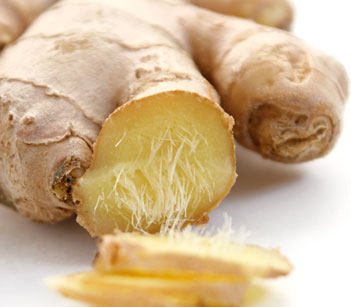
Ginger - The Good Herb


An old Indian saying is “Ginger contains every good quality.”

Ginger is one of the world’s most popular and important spices and is associated with different cuisines like
Chinese, Indian and Caribbean.  It became known in Europe during the Roman period
when it was used as a digestive aid. Around 3000 B.C., Shen Nung, a Chinese herbalist
recommended ginger for cold, fever, chills, and tetanus.  Chinese women still drink
ginger tea for sour throat, menstrual cramps and morning sickness.

In India ginger is also used as a digestive aid.  It appears to relieve indigestion and abdominal cramps by soothing the gastrointestinal tract.  Ginger has anti nausea properties and it contains substances similar to the digestive enzymes that break down proteins.  No wonder ginger ale seems to work like magic in nausea and minor stomach ailments.

Like many spices, ginger has the quality of enhancing and complementing both sweet and savory dishes.  As we use ginger generously in vegetables and meats to enhance the taste, similarly ginger is used in sweet ginger bread and even ginger candy.

Ginger belongs to Zingiberaceae family and other spices of this family are turmeric and cardamom.  The root of ginger is used in the food.  Its botanical name is Zingiber officinale.

Ancient Indians considered ginger a physical and spiritual cleanser.  That might be the reason even to this day during Hindu fasting, onion and garlic is shunned but ginger is still used in the food.


Healing spices from kitchen cabinet

Indian cooking cannot be described without mentioning the importance of herbs and spices.  In fact it is the spices which turn an ordinary vegetable into a gourmet dish.
The medicinal value of these herbs and spices was recognized by Ayurveda, ages ago.  For time immemorial mothers and grand mothers have treated the common problems like cold, headache, cuts, scrapes and many such common ailments with the simple concoction of herbs.  Herbal remedies are the most natural form of therapy.  They heal gently without any side effects and most of them can be found in your kitchen cabinet.
In today’s world, we seem to have forgotten this natural and safe way of healing and have  been popping pills on every small problem without realizing that many drugs in our medicine cabinet have herbal roots.  For the congestion of colds or flu-like symptoms, we prefer Dristan or Combiflam instead of herbal teas or hot milk with turmeric to soothe the throat.
Let us enter an average Indian kitchen and look into the medicinal values of herbs we use almost every day.  It is important to know the effective and safe properties of various herbs, bountifully bestowed on us by Mother Nature.


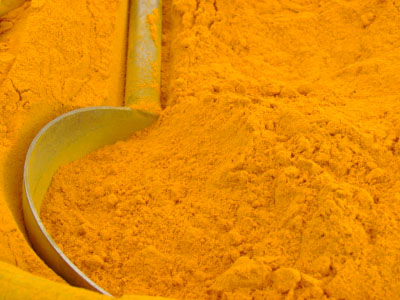
In this blog let us talk about one of the most colourful spice of our kitchen.  Yes, TURMERIC or Haldi as we call in Hindi, is certainly  the golden spice of our kitchen, not just for its rich  colour but for its wonderful medicinal properties as well. 
Turmeric is considered a cleansing herb for the body.  It had been used to cure digestive disorders, arthritis, jaundice and some liver ailments.
Traditional Chinese medicine also used turmeric for liver and gallbladder problems, chest congestion and menstrual discomforts.  Even ancient Greeks were aware of turmeric but unlike Indian and Chinese medicinal usage, they used turmeric for making orange-yellow dyes.

Turmeric is a flowering plant of ginger family.  Its roots are used and its botanical name is Curcuma longa and it is also known as Curcuma.  It belongs to Zingiberaceae family and other members of this family of plants are ginger and cardamom.

Like many culinary herbs, Turmeric helps retard food spoilage due to its antibacterial  properties.  To help 
prevent bacterial wound infection, sprinkle a bit on cuts and scrapes after they have been thoroughly cleaned.
 If someone has cough, it is recommended to drink a cup of milk with half a teaspoon of turmeric boiled in it. 
Add sugar to taste since the aromatic flavor of turmeric might be a bit pungent.

In every blog let us talk about one healing herb from our kitchen.

Sunday, 17 July 2011

High protein salad

Last month I was in Erode for a wedding, a city south of Coimbatore, Tamil Nadu.  The hotel we were staying served us the best breakfast.  Everything was so fresh that every morning I was tempted to overstuff myself and skip lunch at the wedding venue.  Apart from fresh Idli, vada, sambar, uthpum of Ragi and freshly squeezed grape juice, something which caught my fancy was the chickpeas (kabuli channa or garbanzo beans) salad.  For obvious reasons I could not ask the restaurant for the recipe of that salad.  So when I got back home, I decided to try it in my kitchen.  I soaked one cup of chickpeas overnight.  Next morning I boiled them in the pressure cooker.
Other Ingredients:
One medium onion finely chopped, Curry leaves 10 to 15(If you do not have fresh curry leaves, try using fresh basil leaves), salt to taste, lemon pepper, one medium size lemon, a tablespoon of cooking oil,.1/4 teaspoon of mustard seeds, 1/2 teaspoon of cumin seeds.
Method:
Heat cooking oil, add cumin and mustard seeds.
When they stop splatering, add chopped onion.
When onion turn light brown, add curry leaves.
 Add boiled chickpeas to the mixture.
Put salt to taste and lemon pepper.
Before serving add juice of half a lemon.
Now enjoy.

Monday, 11 July 2011

Black Forest Cake with a twist

On my husband's birthday, I baked an oil free black forest cake with a little twist.  Most of the time we have to use lot of whipping cream to make bfc but my cake had icing of white chocolate and fresh cherries . In other words this cake has less calories. 
Here is my recipe:

Ingredients:
Eggs  3, White sugar 1/2 cup, White flour 3/4 cup, Baking powder 3/4 tsp, Vanilla essence a few drops.
Method:
Beat eggs and sugar by placing this pan in another pan of hot water.  When the mixture turns very creamy, add white flour with a wooden spatula.  Pour two tblsp of flour at one time and mix well to avoid making the lumps.  Add baking and vanilla essence. Pour the cake mix in a greased pan.  Bake in 325degree F for 35 to 40 minutes or till the wooden stick comes out clean. 

Let cake cool off for two hours or so. Cut cake into two parts width wise.
Icing:
White baking Chocolate grated three cups, Milk half or 3/4 cup, Fresh or frozen pitted cherries, one grated small chocolate bar for decoration.
Melt white chocolate in a double boiler on a medium heat, add milk. While it is still hot, pour some mixture in the half cut cake.  Fix the other half evenly and now pour rest of the white chocolate on the top of the cake.  Let it dribble on the sides.  Put this in the fridge for ten minutes.  White chocolate will solidfy very soon.  Now decorate with grated chocolate bar and cherries in any way you like.
Your less calories cake is ready for eating.  So enjoy without any guilt.


Monday, 27 June 2011

Letz enjoy creating

It is simply marvelous to see my young niece getting into cooking.  Other day she said : "Now I understand why you don't enjoy restaurant food so much. When you can make salad, pasta, cakes and pies etc better than a restaurant why shouldn't  we choose hygienically cooked food at home.  I do miss the ambience of a good restaurant but is it worth it.  So why not create food like an art.  If we make the everyday ingredients into a novelty, it adds "Wow" element to the finished dish.  In this blog I intend to create fusion foods.  How to give a touch of Indian spice to an Italian sauce.  How to create a pie with leftover biscuits.  We should start on the recipes soon.